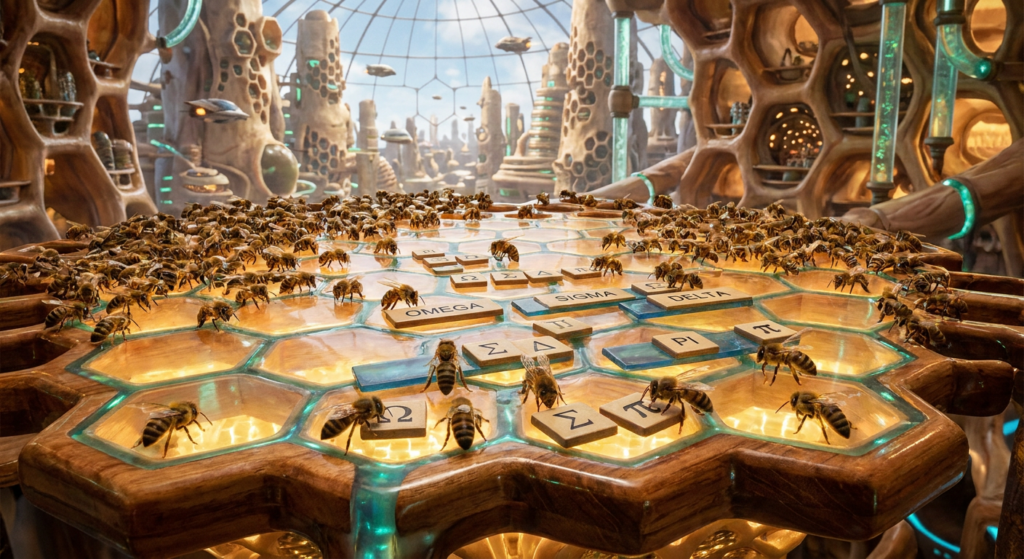
More specifically, would you remember that Dy is the atomic symbol for the element Dysprosium and that you already saw the name “Dysprosium” behind another tile on a game board? Not following? No problem. Just go to Bzzwords Arcade and play the new Elements Concentration memory game.
Advertisement
There are also memory games for the Greek alphabet, Latin vocabulary words and Russian vocabulary words (in Cyrillic.) More are coming.
Has it really been eleven months since the last Bzzwords University update? Whoops. Stuff has happened, let me tell you. First, a simpler version of Trivia Training was introduced, Trivia Training: Lists. In this leaner method, information is only presented in the form of questions and answers. There is no subject study page. Learn by getting it wrong, then right, then maybe wrong again, and eventually right over and over again. Scientists agree: mindless repetition is better than every other learning method combined.
Trivia Training: Lists contains a ton of new topics. The original Trivia Training is now called Trivia Training: Subjects.
Advertisement
You may be asking, “Is that it? Is that all you have to show for eleven months of tireless research and development?” Not by a long shot. We’ve also added a second drilling method called “Cycle 5”. It’s just like the original drilling method, except that all questions are repeated in cycles of five. That means that after you answer a question right or wrong, it will be repeated five questions later. This is even more mindless repetition, and it works.
There is also a new AI-adjacent trivia training method that we the faculty of Bzzwords University developed. More on that soon.
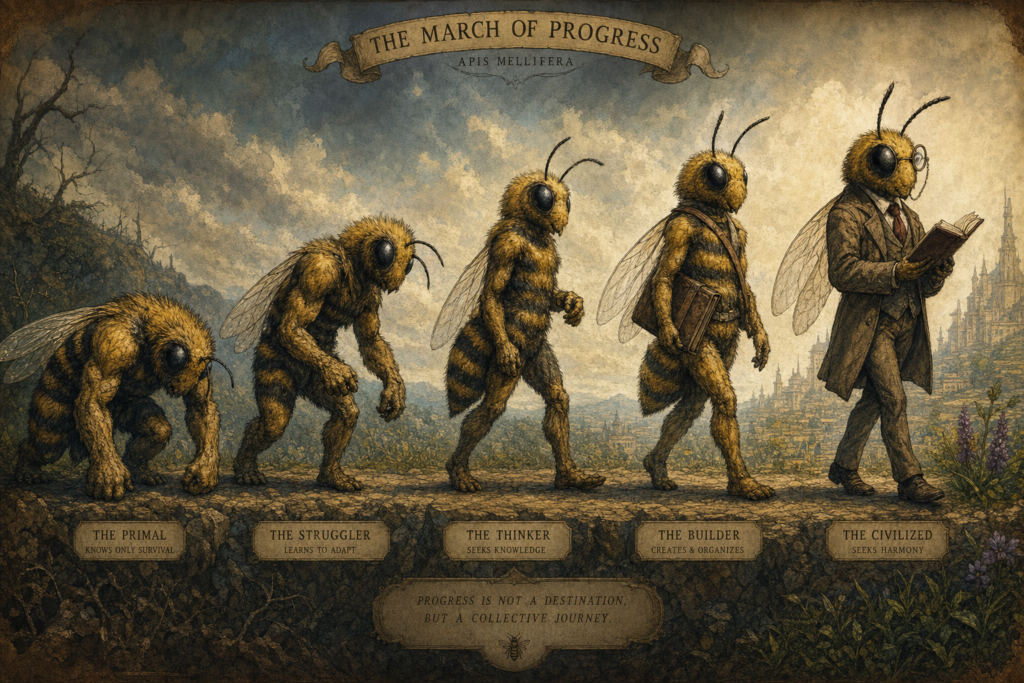
Image: Apparently, honeybees evolved clothing very late in the game.
The ancient Greek city-states such as Athens and Sparta ceased to be independent political entities with the Roman conquest of Greece in 146 BCE. Rome had a military conquest, but you could argue that Greece eventually conquered Rome culturally. Greek became the language of Roman scholarship, and eventually the lingua franca of the entire empire. If you wanted to be able to communicate with anyone in the Empire, you learned Greek, not Latin.
The Romans adopted the Greek gods, mapping them to existing Roman deities with similar domains, e.g. the Greek god of war Ares became the Roman god of war Mars. Greek influence pervaded art and architecture and philosophy, while Greek instructors and teaching methods became the gold standard in Roman education. Eventually, the Eastern Roman Empire become predominantly Greek in language and culture.
But why, you may ask, does any of this matter from a trivia training point of view?
Advertisement
Even after the Roman conquest, Greece continued to produce intellectuals, artists, scientists, and philosophers of historical stature. But these guys were Greeks who lived in ancient times, and there already is a Bzzwords trivia training category for Ancient Greeks. Why do we need another?
We, the expert faculty of Bzzwords University, feel that the Greek scholars under Roman rule were a different breed of cat. They were as much Roman as they were Greek.
Knowing the handful of Roman-Era Greeks that we’ve included here will give you an advantage over run-of-the-mill quizzers. These names will show up on elite trivia shows like Jeopardy, Masterminds, or the Chase, and you will be the only one in the room to know them. Even if you’re just watching one of these shows, and you know that yellow bile is one of the “four humors” of the Greek physician Galen, you will impress the heck out of your date. And how can you call yourself civilized if you don’t know who Plutarch is?
It’s easy to learn. Just drill for a minute here and a minute there at Bzzwords University Trivia Training.
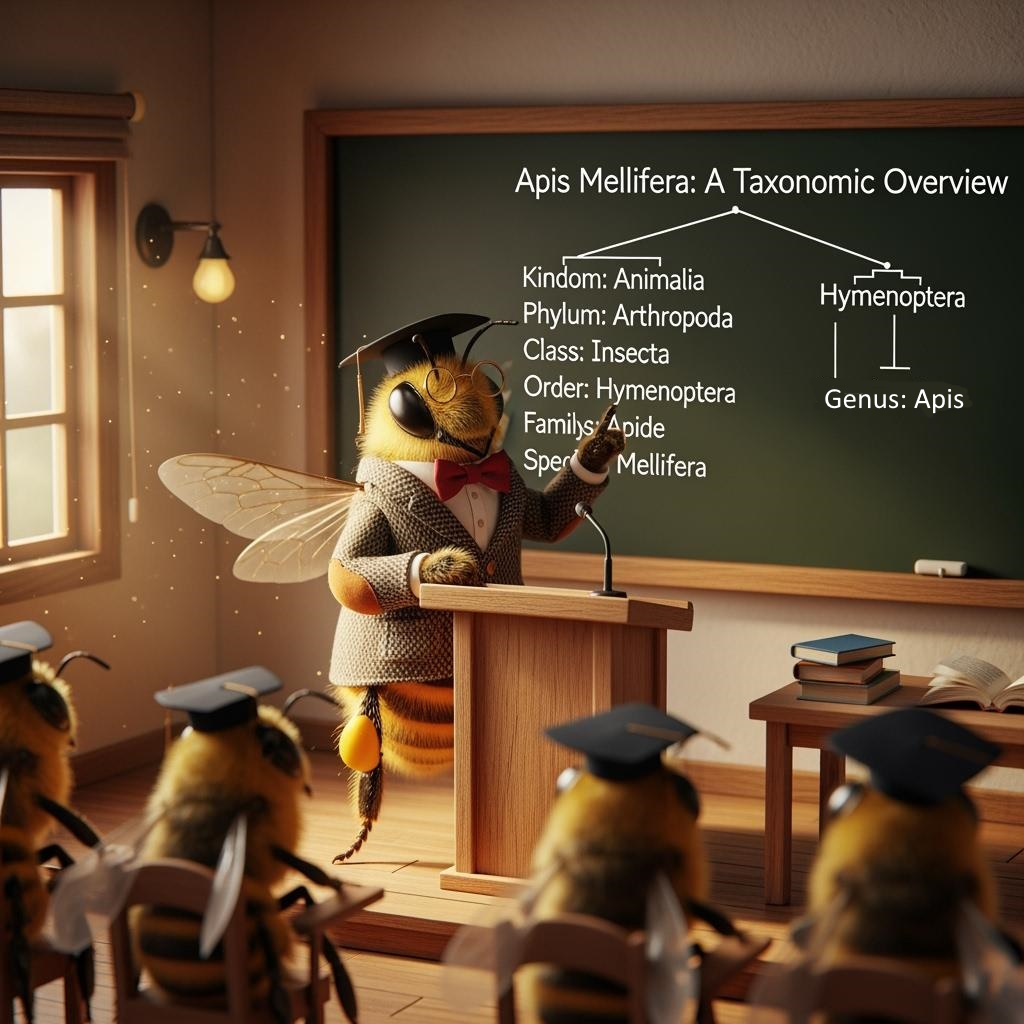
Before Bzzwords University, I was completely ignorant about biological taxonomy. There, I said it. I knew next to nothing about the scientific study of how to classify, name, and categorize living organisms. Walking down the street, wags and wiseacres could call me names like “dunderhead” or “clodpoll”, and they’d be right. But all that has changed.
Advertisement
I went to bzzwords.com and clicked on Bzzwords University, then clicked on Trivia Training. Then I selected Biological Taxonomy from the dropdown menu and clicked on the Drill button. Within minutes, I knew everything. I raised the sword of Trivia Training to the skies, and the glowing lightning bolt of knowledge flowed into my noggin. Now, no one would dare call me a dullard or a schnook.
It’s a well-known fact that the single best way to be incredibly cool is to have an encyclopedic knowledge of opera. In other words, to be an opera buff. But what if you can’t devote the enormous amounts of time and energy needed to achieve this exulted status?
Advertisement
Imagine the following scenario. You are watching Jeopardy with your friends. One of the categories is ‘Opera.’ The first clue is, “This 1904 Puccini Opera Is Set In Nagasaki”. You reply “What is Madama Butterfly?”, and you are right. Your friends are impressed.
The next clue is, “Charles Gounod’s opera adaptation features this title character making a bargain with Mephistopheles.” You reply, “Who is Faust?”, and again you are right. Your friends are stunned.
A third clue says, “In the third act of this Verdi opera, Dr. Grenvil tells Violetta she doesn’t have long to live”. When you correctly reply, “What is La Traviata?”, you become a legend.
In your friends’ eyes, you stride the narrow world like a colossus. You are an opera buff (compared to them.) They don’t notice that you didn’t know the correct response to several of the other opera clues. No, all they remember is that they didn’t have the tiniest idea about any of the responses, and you knew some. It is enough. You have arrived at transcendent coolness.
How then, you ask, can I achieve even this relative buffness? That’s an easy one. Go to www.bzzwords.com. Click on Bzzwords University. Click on Trivia Training. Choose the “Opera” topic from the drop-down menu. Click on the Drill button. Keep answering questions until you get a lot of them right. Then go do something else and come back later to drill again, over and over until you stop forgetting. Don’t try to memorize. Just keeping guessing and eventually the right answers will be there.
That’s it. Soon, you will be able to answer enough trivia questions to convince opera ignoramuses, which is almost everyone, that you are a buff.
So what do you need to know about opera from a trivia training point of view? Know the most commonly performed operas, including La Traviata, Carmen, The Magic Flute, La Bohème, Tosca, The Barber of Seville, Aida, The Marriage of Figaro, Don Giovanni, Rigoletto, Hansel and Gretel, and Madama Butterfly.
Know that Verdi composed a ton of operas from 1839 to 1893. Puccini composed gobs between 1884 to 1926. If you don’t know the composer of an opera, one of those two guys is a good guess, and if you know the date of the premiere, you can usually narrow it down to which one.
Be able to identify the title of the opera from a plot summary. Know the composer of the opera, and the setting. Unlike Shakespeare plays, where you might be asked the name of any character, you only need to know the names of major characters, usually a protagonist and a love interest.
How many plays did Shakespeare write? The Encyclopedia Brittanica says about 37. Other sources say about 38. Why “about”? Apparently, after 400 years, you kind of have to dig around to figure out who wrote what and how much of it. There are multiple versions of almost everything from back then floating around, and you can’t be completely sure which ones are his work with some revision by other authors, and which ones are works by other authors with some revisions by him. The discrepancy between 37 and 38 seems to center around whether or not “Two Noble Kinsmen”, which Shakespeare is believed to have written with a coauthor named John Fletcher, should be considered a Shakespeare play.
Advertisement
We don’t care though. If it’s a famous play commonly attributed to Shakespeare, there’s going to be trivia questions about it.
So from a trivia training perspective, what do you need to know about Shakespeare’s plays? Everything. Every setting, every plot, every named character. For Jeopardy anyway. For lesser shows, you might get away with just knowing that Romeo is a Montague and Juliet is a Capulet.
Casual trivia competition will probably concentrate on just the most famous plays, Hamlet, Romeo and Juliet, and Macbeth. Elite shows like Jeopardy and the Chase will cover these, but tend to concentrate on Shakespeare’s second-tier titles, Othello, King Lear, The Tempest, Twelfth Night, Much Ado About Nothing, and A Midsummer Night’s Dream. There will also be questions about The Merchant of Venice and As You Like it. Even more obscure plays might generate a question if they contain a famous quote, such as “A horse, a horse, my kingdom for a horse,” in Richard III.
Here’s a tip. If you are asked for the name of a secondary character from a Shakespeare play, and you have no idea what it is, guess, “Antonio.” Half of the guys in Shakespeare’s plays are named “Antonio.” Okay, it may just seem like it.
For some reason, I have seen more questions about King Lear’s daughters recently than anything else to do with Shakespeare. Their names are Goneril, Regan and Cordelia. Remember those names. Cordelia is the good one.
You can use “drill” mode at Bzzword University Trivia Training to gently pound these names, and a lot of other very useful facts, into your memory.
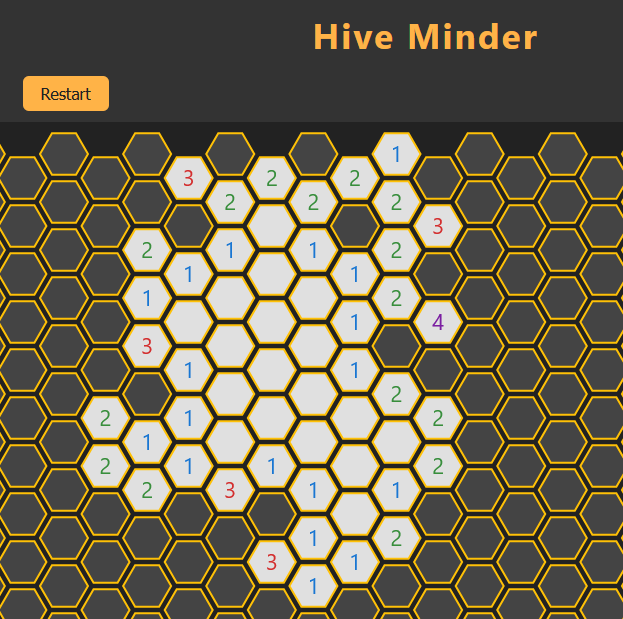
Bzzwords Arcade has returned from its hiatus. Yes, it now has a working game.
Advertisement
Hive Minder is a simplistic, derivative, and fun game. Traipse through a honeycomb and clear the hexagonal cells without clicking on any bees. In each cell, the number of bees in adjoining cells is displayed (unless there aren’t any.)
Yes, yes, like I said, derivative, but this is hexagonal. HEXAGONAL! It will trip you up.
The first thing you need to know about the NBA Hall of Fame is that there isn’t one. Nope. Doesn’t exist. So where are all these NBA players who are inducted into the hall of fame going? That would be the Naismith Basketball Hall of Fame, which honors any significant contributor to the sport of basketball, players and coaches, men and women, professional and amateur, U.S. and international.
Advertisement
So when we at Bzzwords University say, “the NBA Hall of Fame,” we are of course referring the NBA players that have been inducted into the Naismith Basketball Hall of Fame, or at least to a curated subset of that group.
Sports trivia competitions would go into great detail about things like stats and league records and who beat who in the finals in what year. However, that’s not the kind of sports question you’d be likely to encounter on a general knowledge trivia show such as Jeopardy or Master Minds or the Chase.
So for general knowledge trivia competition purposes, what do you need to know about NBA hall of fame players?
Know the twenty or so historically great NBA players and what teams they played for. Examples: Larry Bird played for the Boston Celtics his entire career, Tim Duncan for the San Antonio Spurs, Isiah Thomas for the Detroit Pistons. Shaquille O’Neal played for six different NBA teams.
Know who they played for in college, if they did. Examples: Charles Barkley played for Auburn, Magic Johnson for Michigan State, Shaquille O’Neal for LSU, Larry Bird for Indiana State. Kobe Bryant went to the NBA straight from high school.
Know their nicknames. Examples: Oscar Robertson was “the Big O.” Jerry West was “Mr. Clutch.” Julius Erving was “Dr. J.” Kobe Bryant gave himself the nickname, “Black Mamba.” I doubt Charles Barkley gave himself the nickname, “Round Mound of Rebound.”
Know the most unique facts and accomplishments of the players. Examples: Wilt Chamberlain is the only player to score more than a hundred points in one game. Dirk Nowitzki, from Germany, was the first European superstar in the NBA. The NBA logo is the silhouette of Jerry West.
The most important basketball fact of all time, the most important nugget of information in all of sports of all time from a trivia point of view, more important than all other facts combined, is that the NBA logo is the silhouette of Jerry West. If you can’t learn anything else, learn that.
What about LeBron James, you ask? What about Steph Curry? Don’t worry about them. They aren’t retired yet, so they aren’t in the hall of fame. Questions about current players aren’t as likely on the gold standard trivia shows mentioned above. Once you’ve gathered the low-hanging fruit of NBA hall of fame player facts, move on to the Byzantine Empire.
Canada is very mysterious. Each province and territory has a complex history and society. There’s a ton of fascinating facts you could learn about each of them. But from a trivia training point of view, which of these nuggets of info do you really need to know?
Advertisement
Know that Newfoundland hasn’t been Newfoundland since 2001. It’s “Newfoundland and Labrador” now.
Know that Nunavut is Canada’s northernmost and most recently created territory. It was carved out of the Northwest Territories in 1999, and its small population is majority Inuit.
Know that Newfoundland and Labrador, New Brunswick, Nova Scotia, and Prince Edward Island are the Atlantic provinces. To the west, in order, is Quebec, Ontario, Manitoba, Saskatchewan, Alberta and British Columbia. Know the order.
Know the capitals.
Just these few facts will give you a huge leg up in any trivia competition with a Canadian Provinces/Territories category.
Pound these pegs of knowledge (and many more) into your memory with Bzzwords University Trivia Training.
Thousands of years ago in ancient Mesopotamia, somebody noticed that there were two different sets of lights in the night sky (other than the moon). One set consisted of a large number of tiny lights that rose and set every night, but always seemed to stay in the same position relative to each other. The ancients organized some of these well-behaved lights into groups that today we call constellations. The spot on the horizon where a particular constellation rose moved westward a little bit every night until, a year later, it circled all the way back where it had started (some constellations actually disappeared for a while during parts of the year.)
Advertisement
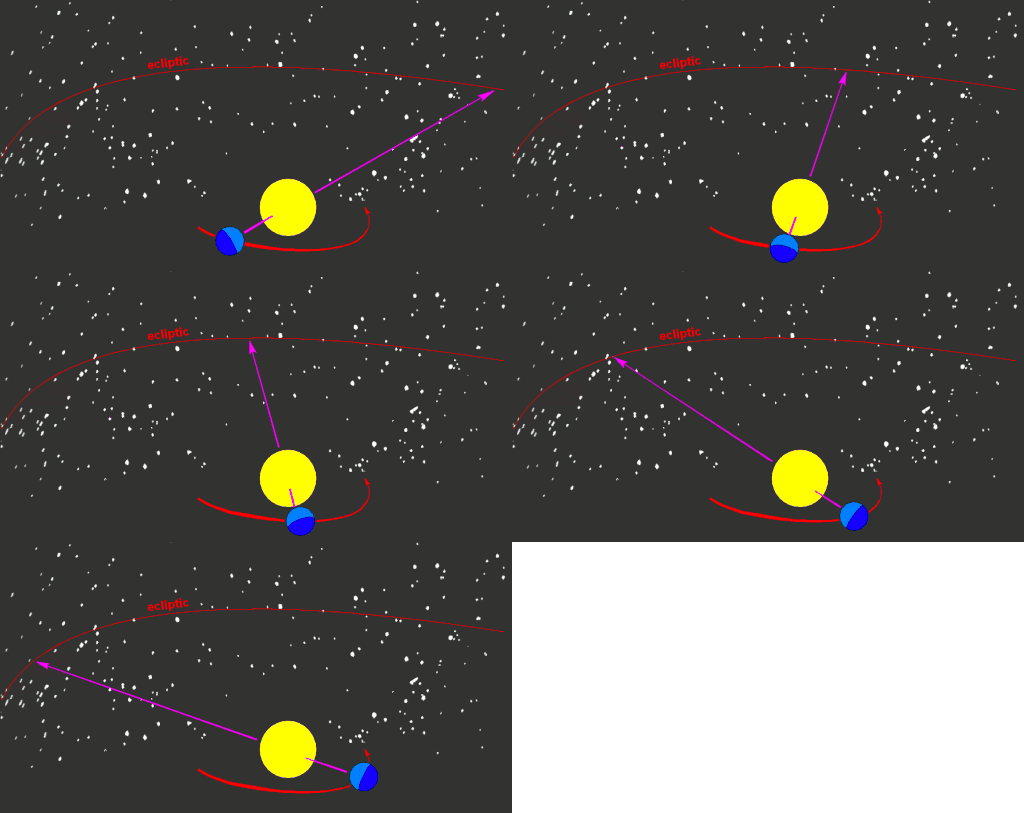
There was a second set of lights in the night sky, and these did not stay fixed in position relative to anything. The peoples of Mesopotamia called these wandering lights “wild sheep.” They noticed that the wild sheep always moved through a specific path of constellations. The sun too, over the course of a year, moved along this path. Today, we call that path “the ecliptic,” and the sequence of constellations along that path “the Zodiac.”
The fixed lights are, of course, stars. They’re so far away from us that the distance that the earth moves while revolving around the sun is not large enough to produce a noticeable change in perspective. Thus, the stars appear fixed in position relative to each other. To the ancients, the stars seemed like a big, slowly rotating backdrop in the sky.
The wild sheep are the planets revolving around our sun. Our word “planet” comes from a Greek word meaning “wanderer.” All of the planets in our solar system revolve in roughly the same plane, so the planets and the sun all appear to travel along the ecliptic path.
The twelve constellations of the Zodiac are Aries, Taurus, Gemini, Cancer, Leo, Virgo, Libra, Scorpio, Sagittarius, Capricorn, Aquarius, and Pisces. There are a lot more constellations in the night sky, 88 officially recognized by the International Astronomical Union (IAU), but the constellations of the Zodiac are the ones that are in the path of the ecliptic. The dates for each Zodiac sign indicates when the sun is directly between the earth and that constellation. For example, the sun is directly between earth and the constellation Aries from March 21st to April 19th. Anyone born in that date range is said to be born under the sign of Aries.
Let’s try a little thought experiment. Suppose there was a total eclipse on April 5th and you could briefly see the stars during the day. Try to find the constellation Aries. Sorry, you can’t. It’s directly behind the sun. The sun is eclipsing Aries. Experiment over.
There’s actually a thirteenth constellation, Ophiuchus, the Serpent Bearer, that also lies in the path of the ecliptic. The peoples of ancient Mesopotamia, however, didn’t like the number thirteen. They liked twelve. Also, they wanted to align the whole thing with the twelve months of the lunar calendar. Ophiuchus was out.
In the U.K., the constellations Scorpio and Capricorn are more commonly referred to by the Latin names Scorpius and Capricornus, which are the astronomical rather than astrological designations.
Shove all this knowledge (and more) into your head at BzzWords University Trivia Training.
Image: A ram against a backdrop of meaningless scribbling.